
The Physics of Digital Imaging: Balancing Perceptual Quality and Byte Weight
Images account for over 65% of the total byte weight transferred across modern web applications. Delivering unoptimized, uncompressed raster graphics degrades Core Web Vitals (specifically Largest Contentful Paint - LCP), increases cloud CDN bandwidth egress expenses, and results in frustrating bounce rates for mobile users on cellular connections.
Image optimization requires understanding the mathematical trade-offs between Predictive Intra-Frame Compression (WebP / AVIF), Lossless Raster Matrices (PNG / TIFF), and Resolution-Independent Vector Geometry (SVG).
Format Efficiency & Use-Case Matrix
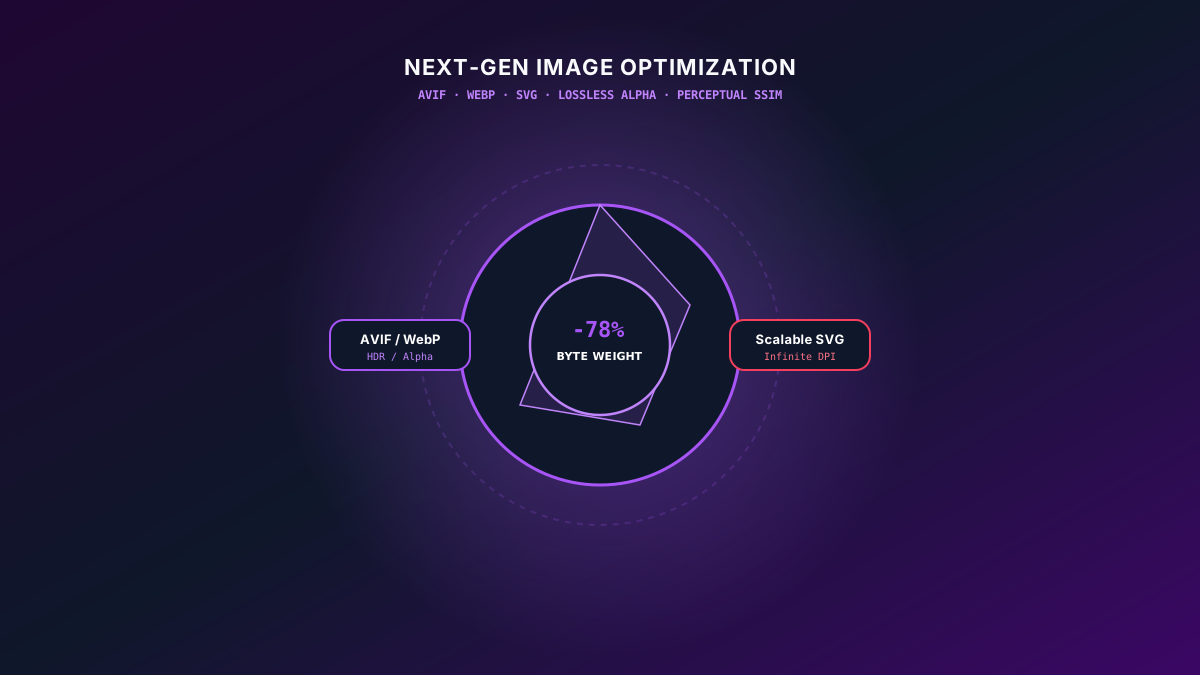
Best for web delivery and photography. AV1-derived compression achieves 70%+ savings over JPEG at equal SSIM quality.
Best for brand logos, UI icons, and technical schematics. Infinitely scalable with zero byte inflation on 4K/8K displays.
Best for commercial print and medical imaging. Supports 48-bit color depths, CMYK profiles, and uncompressed alpha layers.
1. Modern Encoding Formats: AVIF and WebP Deep-Dive
AVIF (AV1 Image File Format) and WebP represent the bleeding edge of raster optimization. By leveraging directional spatial intra-prediction, transform coding, and adaptive chroma subsampling (4:2:0 and 4:2:2), these formats eliminate banding artifacts in gradients while preserving sharp high-frequency edges.
2. Color Gamut Management: sRGB, Display P3 & Prepress CMYK
Converting images between digital RGB color spaces and physical CMYK printing profiles requires calibrated ICC transformation matrices. SwiftFileConvert ensures that color profile tags are accurately translated without uncalibrated muddying of brand pigments.
Conclusion
Standardizing your image pipeline on modern AVIF/WebP formats and vector SVGs drastically accelerates web performance while maintaining flawless visual fidelity.